
Table of Contents
Summary of Service
UsenetExpress is a Tier-1 Usenet provider that operates its own servers and independent backbone, which immediately sets it apart from reseller-based services. Founded in 2016, the provider has earned a reputation for fast speeds, dependable performance, and a strong focus on user privacy. With server locations in both the United States and Europe, UsenetExpress delivers low-latency, high-bandwidth connections for users worldwide. All unlimited UsenetExpress plans include a free VPN, branded as the UsenetExpress VPN, providing an added layer of privacy beyond Usenet access itself. The service enforces a strict no-logs policy and protects all connections with 256-bit SSL encryption using 2048-bit certificates, keeping downloads secure and private.
UsenetExpress offers both unlimited subscription plans and a block plan, giving users flexibility based on their download habits. By default, accounts support up to 50 simultaneous connections, which is more than enough to fully utilize most home internet connections. For heavy users, the connection limit can be upgraded to as many as 150 connections. The provider advertises uncapped speeds with no throttling, and in practice, it is capable of saturating even gigabit-speed connections. UsenetExpress operates as part of a small independent Usenet network alongside its partners NewsDemon and NewsgroupDirect. Both providers use the UsenetExpress backbone, meaning all three services share the same underlying infrastructure. This arrangement was finalized around 2020 when NewsDemon moved off a mainstream backbone onto the UsenetExpress network. As a result, performance factors such as speed, completion rates, and article availability are largely identical across these providers. The main differences come down to pricing, retention policies, and how each service positions itself.
Overall, UsenetExpress presents itself as a no-frills, high-performance Usenet provider geared toward users who prefer supporting independent backbones without giving up speed, reliability, or privacy.
Retention & Completion
Retention measures how long articles remain available on a provider’s servers. UsenetExpress currently advertises over 4,000 days of binary retention (about 11 years), and that figure continues to grow. In real-world use, many posts extend beyond that range, though UsenetExpress doesn’t yet reach the 5,600+ day retention claimed by some competitors. For comparison, NewsDemon and NewsgroupDirect advertise roughly 5,600 days of retention. The difference largely comes down to backfilling and multi-backbone access, while UsenetExpress focuses on building its own retention organically. According to the provider, about 94% of article requests are now served directly from its own servers, with only very old posts pulled from partners when needed. In practice, anything posted within the last decade is readily available and downloads quickly. Extremely old binaries (12+ years) may occasionally be incomplete, but this is becoming less common as retention deepens.

Completion is a strong point. UsenetExpress reports 99%+ completion rates, and that aligns well with typical user experience—as long as a file hasn’t been removed due to a takedown, it generally downloads cleanly. Because NewsDemon and NewsgroupDirect use the same backbone, completion on recent content is effectively identical across all three services.Takedowns are worth noting. UsenetExpress is U.S.-based and complies with DMCA requests, so copyrighted content may be removed relatively quickly. This applies equally to NewsDemon and NewsgroupDirect. “Uncensored newsgroups” simply means no group-level filtering, not immunity from legal takedowns. Some European providers, such as Eweka, may retain certain files longer under EU policies, but results vary.
Overall, while UsenetExpress doesn’t lead the market in raw retention numbers, it still offers more than a decade of binaries with excellent completion and fast access. Unless you’re specifically hunting rare content from the mid-2000s, the practical difference is minimal. Its advertised retention also reflects what it actually hosts, rather than inflated figures from layered backbones, keeping performance strong and pricing competitive while retention continues to expand.
Pricing
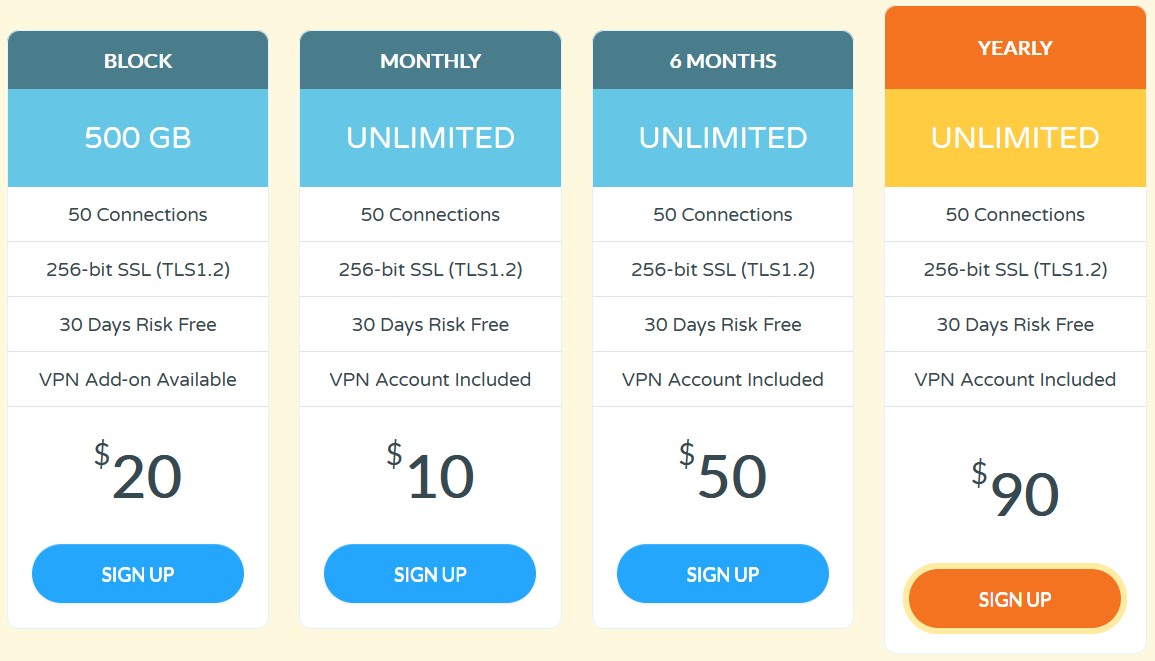
UsenetExpress keeps its pricing straightforward and very competitive. Here are the current plans offered on their website:
- 500 GB Block: $20 one-time. This block account gives you 500 GB of download data with no expiration date. It supports 50 connections and SSL. (VPN is not included by default, but a VPN add-on is available if you choose.) Since it’s one-time, there are no recurring fees – great for casual users or as a backup block to pair with another provider.
- Unlimited Monthly: $10 per month, recurring. This is an unlimited download subscription. It includes 50 connections, SSL encryption, and a VPN account at no extra cost. There’s no speed cap on usage. It’s a month-to-month plan, so you can cancel anytime.
- Unlimited 6-Month: $50 every 6 months. This works out to about $8.33 per month, a slight discount for paying semi-annually. It includes everything the monthly plan does (unlimited data, 50 connections, VPN). It’s a good middle-ground if you’re comfortable prepaying for half a year.
- Unlimited Yearly: $90 per year. This brings the effective monthly cost down to $7.50, which is excellent value for unlimited Usenet + VPN. All features (50 connections, SSL, VPN) are included. For heavy users or anyone planning to stick with the service long-term, the annual plan offers the best bang for the buck.
All UsenetExpress plans include a 30-day risk-free guarantee, essentially a full money-back window during the first month if the service isn’t a good fit. It’s a reassuring policy, especially for new users. Another standout feature is connection flexibility: while all plans include 50 connections by default (already enough to max out nearly any home internet connection), UsenetExpress uniquely allows upgrades up to 150 connections for an added fee—something most users won’t need, but power users may appreciate.
Pricing-wise, UsenetExpress sits firmly in the affordable tier, though its sister services approach pricing differently. NewsDemon is well known for aggressive, short-term promotions. Deals like discounted multi-month unlimited plans with VPN included, ultra-cheap capped plans for light users, and heavily discounted block accounts pop up regularly. If you’re willing to watch for sales, NewsDemon can often undercut UsenetExpress on price.
NewsgroupDirect, on the other hand, positions itself as a consistent low-price leader. It publicly commits to matching or beating competitor pricing and typically lists slightly cheaper monthly and yearly unlimited plans. NGD also runs its well-known “Terabyte Tuesday” promotions, offering deeply discounted block data through its newsletter. Because all three providers use the same backbone, these lower prices are more about marketing strategy than differences in underlying service. UsenetExpress doesn’t rely on flash sales or coupons. Instead, it sticks to straightforward pricing, with its yearly plan offering particularly strong value without the need to chase deals or manage promo terms. For users who want simplicity and predictable billing, that approach will be appealing.
Bottom line: UsenetExpress is already competitively priced, but NewsDemon and NewsgroupDirect offer alternate ways to access the same network for potentially less money if you’re deal-focused. All three rank among the most affordable premium Usenet providers available today, delivering high-end performance at prices far below legacy services.
Free Trial Details or Money Back Guarantees
UsenetExpress does not offer a traditional free trial where you use the service before paying. Instead, all plans come with a 30-day money-back guarantee, marketed as “30 Days Risk Free.” You sign up, pay upfront, and can request a full refund within the first month if the service doesn’t meet your expectations. As with most Usenet providers, the guarantee has reasonable limits. Refunds are typically honored when a customer is unable to properly use the service or has only used a modest amount of data. In other words, it’s designed as a genuine trial period—not a way to download terabytes and then ask for your money back. For normal testing and evaluation, however, it works as a practical safety net.
NewsDemon and NewsgroupDirect follow a similar approach. NewsgroupDirect explicitly states a 30-day, 15 GB money-back guarantee, which is plenty for testing speed and completion. NewsDemon also offers a 30-day refund window, with implied usage limits to prevent abuse. Occasionally, NewsDemon runs short-term promotions that include a small free or low-cost trial, but these are not consistently available.
Overall, all three providers favor a risk-free refund model over traditional free trials. For new or uncertain users, this setup works well: you can sign up, test performance for a couple of weeks, and cancel with a refund if it doesn’t meet your needs. In practice, UsenetExpress performs as advertised for most users, so the guarantee is more of a reassurance than something you’re likely to need—but it’s good to know it’s there.
Special Offers
At the time of writing, UsenetExpress is not featuring any flashy limited-time promotions on its site – its value is mainly in the standard pricing discussed above (especially the effectively $7.50/mo yearly deal). They occasionally may partner with deal sites or forums for discount codes, but it’s not a big part of their model. Instead, the long-term discounted subscriptions *are* the deal. That said, if you’re shopping around, it’s impossible not to notice the special offers from their competitors/partners, which can be quite eye-catching:
- NewsDemon: This provider is known for regular sales and bundle deals. For example, a recent “Back to School” promo offered unlimited Usenet + VPN for 6 months at just $22. They’ve also sold large block accounts (500 GB, 1 TB, etc.) for mere dollars during promotions. NewsDemon’s strategy is to periodically drop these big sales (often around holidays, Black Friday, New Year, etc.) to attract users. Additionally, NewsDemon introduced features like a “Vacation Pause” on accounts (allowing you to temporarily suspend your sub if you won’t use it for a while) as a customer-friendly perk – not exactly a price discount, but a value-add that saves you money if you need it.
- NewsgroupDirect: NGD runs the famous “Terabyte Tuesday” as mentioned – typically once a month (often the first Tuesday), subscribers to their newsletter get offers for deeply discounted block packages or special multi-backbone subscription deals. For instance, you might see offers like “2 TB for 50% off” or an upgrade to their Triple Play plan at a reduced rate. NGD also sometimes gives bonus gigs or account credits during special events. Moreover, NGD’s everyday price matching policy is itself a standing offer: they claim to beat any backbone provider’s price by 10%, which is why their base rates are a bit lower than UsenetExpress by default. They essentially turned competitive pricing into a permanent promotion.
Between the three services, pricing strategy is where they really differ. NewsDemon is the most aggressive, often featuring eye-catching sale banners and short-term promotions. NewsgroupDirect tends to play it quieter, frequently adjusting prices to remain the cheapest option and rewarding subscribers with discounted block deals via its mailing list. UsenetExpress, by contrast, sticks to consistent, everyday pricing without relying on flash sales. If you enjoy bargain hunting, it can pay to time a purchase or follow NGD’s deals closely. That said, even without discounts, UsenetExpress’s standard pricing is already very competitive for the level of service it delivers. One often-overlooked value add is the included VPN on unlimited plans. While some providers charge extra for VPN bundles—or don’t offer one at all—UsenetExpress includes it by default, which effectively adds a few dollars of monthly value.
It’s worth setting expectations, though. The included VPN (Ghost Path, branded as UsenetExpress VPN) is solid for basic privacy and securing your connection, but it’s not a replacement for a top-tier standalone VPN. Power users who rely heavily on advanced VPN features may still prefer a dedicated service. Still, as a built-in bonus, it’s a welcome extra—and one that NewsDemon and NewsgroupDirect also include. Overall, NewsDemon is the place to look if you love chasing deals, while NewsgroupDirect quietly caters to price-sensitive users year-round. UsenetExpress may not shout about discounts, but its stable, low pricing often works out just as well over the long term—especially if you value simplicity and don’t want to switch providers constantly.
Access Speed
UsenetExpress is built for speed, and in practice it delivers. Its infrastructure is designed to fully saturate your internet connection, whether you’re on a modest broadband line or gigabit fiber. The network is backed by multiple 10 Gbps links at each server location and several 100 Gbps uplinks across multiple backbone providers. In plain terms, bandwidth is not a limiting factor here.Real-world performance reflects that design. Users routinely report near line-speed downloads, and our experience matches that. Even using a fraction of the available 50 connections is usually enough to max out a fast home connection, leaving plenty of headroom for power users.

Because NewsDemon and NewsgroupDirect share the same backend infrastructure, raw download speeds are effectively identical across all three services. One small distinction is that NewsDemon operates an additional U.S. West Coast server cluster for its members, which can slightly improve latency for users on the West Coast or in parts of Asia-Pacific. UsenetExpress and NewsgroupDirect primarily rely on U.S. East Coast and European servers, though in most cases the difference is negligible thanks to multi-threaded downloads.NewsgroupDirect also offers optional multi-backbone access on higher-tier plans, allowing downloads from additional networks if needed. While this can provide redundancy in rare edge cases, the UsenetExpress backbone alone is fast and stable enough that most users will never notice a difference. All three providers advertise uncapped speeds, and none impose artificial throttling.
As always, local setup matters. UsenetExpress supports all common SSL ports, including port 443, which can help bypass ISP traffic shaping. SSL encryption alone is sufficient for most users, though an included VPN is available if desired. In testing, speeds remain excellent either way.
Bottom line: speed is a non-issue here. UsenetExpress, NewsDemon, and NewsgroupDirect can all comfortably saturate a 1 Gbps connection and perform on par with larger legacy providers. The network is mature, reliable, and handles peak traffic without issue, making performance one of the strongest aspects of these services.
Server Connections / Configuration
UsenetExpress offers plenty of flexibility when it comes to connections and configuration. By default, all accounts include up to 50 simultaneous connections, which is effectively unlimited for most users. In real-world use, far fewer connections are usually enough to max out even very fast internet lines, but the higher limit ensures smooth performance when downloading multiple files or running multiple clients.For edge cases, UsenetExpress also allows users to upgrade an account to as many as 150 connections. This is a rare offering and largely unnecessary for typical users, but it’s available for power users with multi-gigabit connections or specialized setups. By comparison, NewsDemon and NewsgroupDirect both include 50 connections on standard plans, with NewsgroupDirect offering higher limits on its multi-backbone tiers.
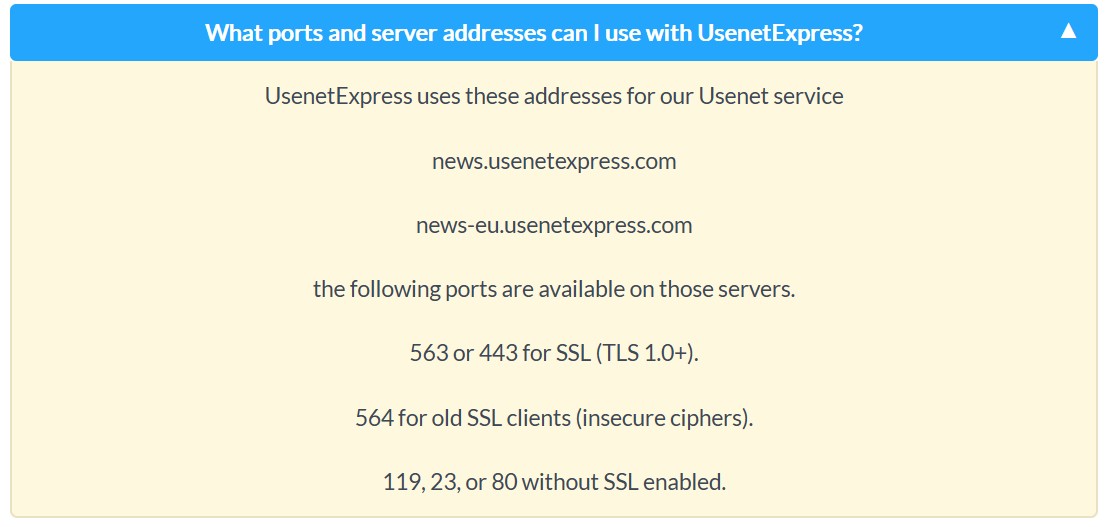
Server configuration is straightforward. UsenetExpress provides separate U.S. and EU server addresses, allowing users to connect to the closest region for optimal routing. Content is identical on both—only the geographic path differs. The service supports all common NNTP ports, including SSL ports 563 and 443 (the latter is especially useful for bypassing ISP restrictions). Unencrypted ports are also available for compatibility, though SSL is recommended and supported across all modern newsreaders.
Setup simply involves entering the server address, enabling SSL, and using your account credentials. UsenetExpress provides solid documentation and guides for popular newsreaders, along with more advanced setups such as NAS devices and router-level VPN configurations.NewsDemon and NewsgroupDirect are configured in much the same way, using their own branded server hostnames but accessing the same underlying infrastructure. NewsgroupDirect’s higher-tier plans may require adding extra server addresses for additional backbones, but this is optional and well documented. All three providers enforce a one-IP-at-a-time policy, which is standard across the industry to prevent account sharing.
Overall, UsenetExpress’s server setup is modern, flexible, and easy to work with. Connection limits are generous, server options cover all common scenarios, and configuration is no more complex than with its sister services. For most users, it’s a plug-and-play experience with no special tweaking required.
Provided Newsreader
UsenetExpress does not bundle a proprietary newsreader with its service, which is typical for independent Usenet providers. Instead, it supports all standard NNTP-compatible newsreaders and provides setup guides and recommendations on its website. Users are free to choose their preferred software, whether that’s paid clients like Newsbin, popular automation tools like SABnzbd or NZBGet, or traditional clients such as Thunderbird or Unison for text groups.
This approach differs from larger providers like Newshosting or Easynews, which include custom apps or web-based interfaces. UsenetExpress (along with NewsDemon and NewsgroupDirect) assumes users will bring their own client. The upside is flexibility—you’re not locked into proprietary software—and the downside is an extra setup step for beginners. In practice, UsenetExpress’s documentation makes this fairly painless, even for newcomers.
All unlimited UsenetExpress plans include free header downloads and header compression, which is a nice bonus for users who still browse newsgroups the traditional way. Posting to newsgroups is also supported on unlimited plans, giving full read/write access through your chosen newsreader. There’s no web-based posting or browsing tool, so everything runs through third-party software.
NewsDemon and NewsgroupDirect follow the same model: no bundled client, full compatibility with standard newsreaders, and easy switching between providers by simply changing server credentials. Overall, UsenetExpress’s lack of a custom app isn’t a drawback—it’s a deliberate choice that favors performance and flexibility over hand-holding. If you want a streamlined, classic Usenet experience and don’t mind choosing your own software, it’s a solid setup.
Support Review
UsenetExpress offers reliable, knowledgeable customer support primarily through email and a ticket system in the member area. Technical support is monitored 24/7, while billing inquiries are handled during standard business hours. In practice, response times are generally quick, often within a few hours. Because UsenetExpress is run by a smaller, hands-on team, support requests are typically handled by people who actually understand the network, not scripted call-center staff. One of UsenetExpress’s strongest assets is its documentation. The FAQ and knowledge base are extensive and well written, covering setup, troubleshooting, feature explanations, and VPN usage. Many common issues can be resolved without contacting support at all, which power users in particular will appreciate.
Support for NewsDemon and NewsgroupDirect is effectively the same, as all three share infrastructure and staff. NewsDemon is especially visible in community spaces like Reddit, where staff occasionally engage directly with users and announce updates. NewsgroupDirect, which has been around since 2004, also maintains a solid support reputation. One minor caveat involves the bundled VPN. Since it’s powered by Ghost Path, VPN-related issues may occasionally require extra coordination, which can add slight delays. This doesn’t affect Usenet service itself, but it’s worth noting if you plan to rely heavily on the VPN. There’s no live chat or phone support, which is typical for Usenet providers (aside from premium tiers from companies like Giganews). Still, the email-based system works well, policies are clearly documented, and the overall support experience feels personal and competent.
Bottom line: support across UsenetExpress, NewsDemon, and NewsgroupDirect is consistently strong, responsive, and transparent. You’re unlikely to gain better support by switching between them—and in many cases, you’ll get a more personal touch here than with larger, more corporate providers.
Payment Options
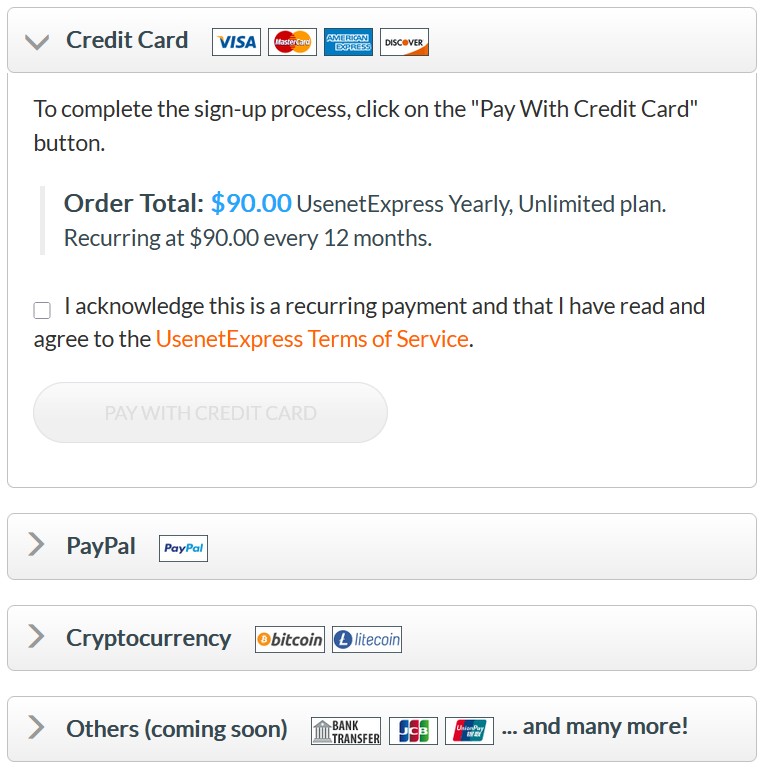
UsenetExpress supports a wide range of payment options, including all major credit and debit cards and PayPal. For users who prioritize privacy, UsenetExpress also accepts Bitcoin, which allows you to subscribe without sharing traditional financial details—just an email address for account access. This fits well with the provider’s overall privacy-first positioning.
From a security standpoint, payments are handled through a third-party processor, and UsenetExpress does not store full card details on its own servers. Their FAQ even outlines steps for users who want maximum anonymity, such as using prepaid cards and privacy-focused browsing methods—an uncommon level of transparency in this space.
Within the same ecosystem, NewsDemon offers standard card payments and additional options geared toward international users, including SEPA direct debit and iDeal, which are especially convenient for European customers. Crypto payments are not prominently advertised there. NewsgroupDirect similarly supports mainstream payment methods, though it focuses more on price matching than expanding checkout options.
Bottom line: UsenetExpress offers one of the more privacy-friendly payment setups among premium Usenet providers, thanks to its Bitcoin support. Between UsenetExpress, NewsDemon, and NewsgroupDirect, most users—whether in the U.S. or Europe—will find a convenient and secure way to pay.
Final Thoughts
UsenetExpress has matured into a genuinely top-tier Usenet provider, offering a strong balance of performance, privacy, and price. As an independent backbone operator in a space dominated by a few large networks, it delivers exactly what most Usenet users care about: fast, reliable downloads, excellent completion on binaries, and no unnecessary complications. The inclusion of a VPN and support for Bitcoin payments further reinforces that UsenetExpress understands the priorities of privacy-conscious, experienced users. Its close relationship with NewsDemon and NewsgroupDirect means that choosing UsenetExpress also plugs you into a broader independent ecosystem that competes directly with legacy giants like Newshosting and Giganews. That competition is healthy for the Usenet space overall, helping keep prices reasonable and innovation alive.
UsenetExpress isn’t a perfect fit for everyone. If you want a one-clickap browser-based interface or a bundled app, a provider like Easynews may be more appealing. If your primary goal is accessing extremely old binaries from 15+ years ago with maximum native retention, you may want a provider with deeper historical archives or a multi-backbone setup. Those are edge cases, though. For the vast majority of users—especially those running automation setups like Sonarr, Radarr, and SABnzbd, UsenetExpress hits the sweet spot. It’s particularly well suited for users who want straightforward, affordable unlimited access backed by a fast, modern network.
When comparing UsenetExpress, NewsDemon, and NewsgroupDirect, the differences largely come down to pricing strategy and extras. NewsDemon often wins on short-term promotional deals, NewsgroupDirect appeals to bargain hunters and block-account collectors, and UsenetExpress stands out for its consistency, simplicity, and more privacy-friendly payment options. Strip away the marketing layers, though, and the core service across all three is equally strong—UsenetExpress just happens to be the source network behind it all.
Bottom line: UsenetExpress is a provider we can confidently recommend. It’s fast, private, reliable, and competitively priced. While it doesn’t chase flashy features, it nails the fundamentals and continues to improve where it matters, especially retention depth. For users tired of overpaying for legacy providers, UsenetExpress is an easy upgrade—and one that delivers where it counts most. If your benchmark is simple—do downloads complete quickly and fully?—UsenetExpress passes with flying colors.