
Table of Contents
Pure Usenet is a long-running Dutch Usenet provider (operating since around 2000) known for its low-cost, no-frills service. Like peers such as XLNed and UsenetBucket, Pure Usenet offers unlimited downloading with tiered speed plans, aiming to let users pay only for the bandwidth they need. All plans include SSL encryption and access to a vast range of newsgroups (over 120,000 groups), and the focus is firmly on core Usenet performance rather than extra features.
At first glance, Pure Usenet’s pricing undercuts many bigger providers, but does this budget approach entail any compromises? In this review, we break down Pure Usenet’s retention, speed, support, and more – and compare its strengths and weaknesses head-to-head with XLNed and UsenetBucket. The tone here is confident and a bit skeptical, because even a “pure” Usenet service can have hidden tradeoffs. Let’s dive in and see who Pure Usenet is best suited for – and who might want to look elsewhere.
Retention & Completion
Pure Usenet currently provides roughly 4,100 days of binary retention (over 11 years of posts kept on the servers). This is a solid retention period for a value-priced service – it matches XLNed’s retention (both providers appear to use the same backbone, so their article archives are essentially identical). In contrast, UsenetBucket’s retention is much shorter (around 1,600 days, or about 4.5 years), which is a notable limitation if you’re hunting for very old content. All three providers claim high completion rates (around 99%+), meaning that within their retention range, most articles should be available and intact.
It’s worth noting that Pure Usenet’s 4,100-day retention, while extensive, is not the absolute highest on the market. Top-tier providers like Newshosting or Eweka boast 6,000+ days of retention – nearly 17 years – so hardcore archivists might find Pure’s depth a bit lacking in comparison. For most users, 11 years of retention is more than enough for everyday use and typical binary downloads.
Completion in practice can be affected by takedowns. Pure Usenet (and XLNed) operate on an international server network that complies with DMCA or similar content removal requests, so some posts (especially copyrighted binaries) may disappear before reaching full retention. UsenetBucket, being EU-based, follows European notice-and-takedown rules – different laws, but in the end they also remove infringing content. The bottom line: all three services generally have excellent completion for what they host, but none are immune to missing articles if those posts were removed for legal reasons. This is a reality many glossy reviews gloss over, but it’s an important caveat if you’re wondering why a supposedly “99% complete” provider might still have gaps on certain files.
Pricing
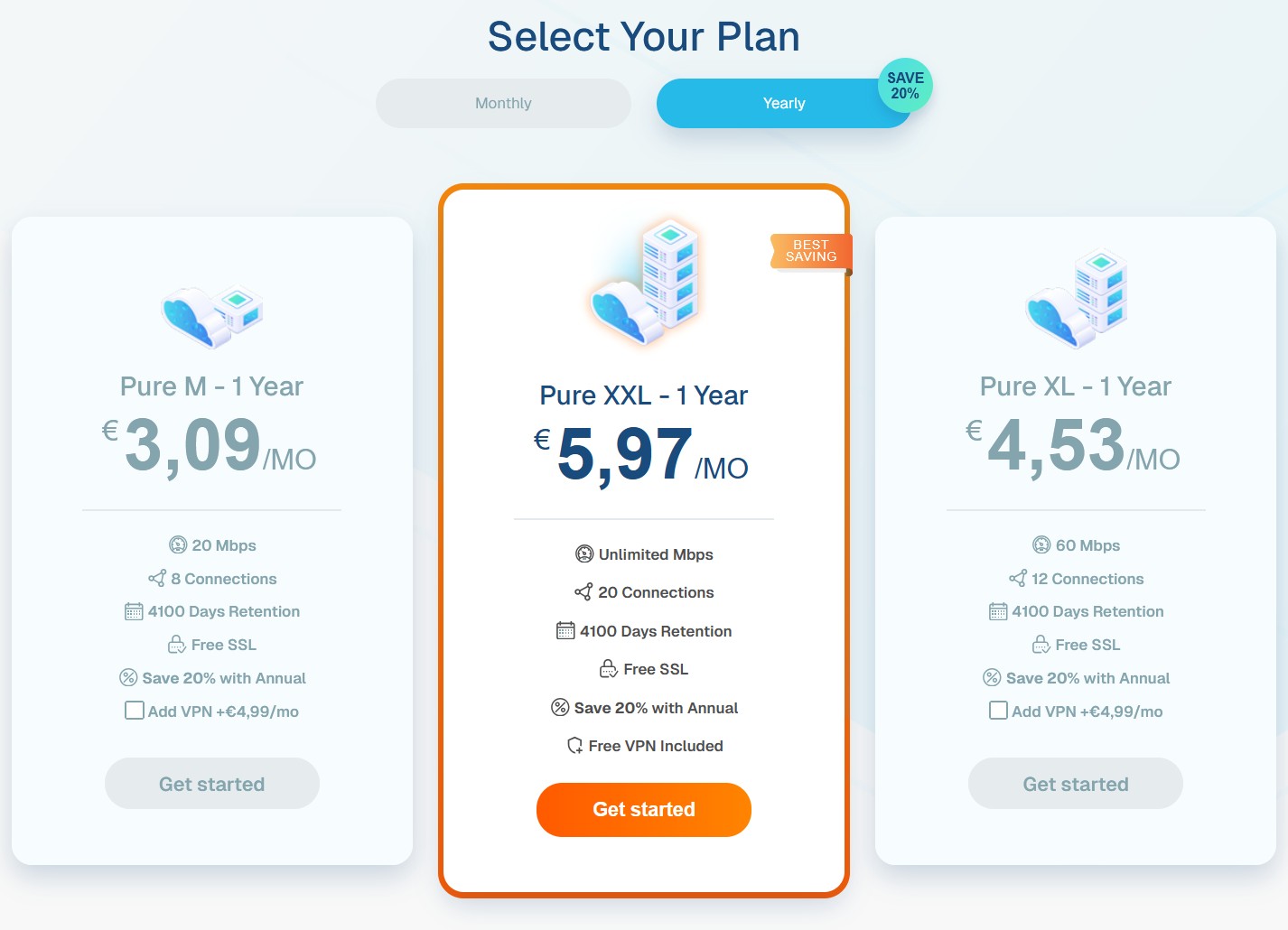
Pure Usenet keeps things simple with three subscription tiers. All plans include unlimited data downloads (no monthly transfer caps) – the difference is in speed limits and number of connections. You can pay month-to-month or annually, with a 20% discount if you choose a 1-year term. Here are the current Pure Usenet plans and prices:
- Pure M: Download speed capped at 20 Mbps, up to 8 connections. Costs €3.87 per month (or ~€3.09/month if paid annually).
- Pure XL: Download speed capped at 60 Mbps, up to 12 connections. Costs €5.67 per month (or ~€4.53/month on an annual plan).
- Pure XXL: Unlimited download speed (no cap), up to 20 connections. Costs €7.47 per month (or ~€5.97/month with an annual subscription). Note: On the XXL plan, if you subscribe for a full year, Pure Usenet includes a VPN service for free; on a monthly XXL subscription (or on M/XL plans), a VPN can be added for an extra €4.99/month.
Compared to its rivals, Pure Usenet’s pricing is very competitive for what you get. XLNed offers a wider range of speed tiers (five plans versus Pure’s three), including an ultra-cheap plan around €2.50/month – but that entry “XL Lite” package only gives you 2.5 Mbit/sec, which is extremely slow by today’s standards. Pure’s cheapest option is more expensive than XLNed’s lowest, but you’re also getting 8 times the speed (20 Mbps) as a baseline. On the high end, Pure’s €7–€6/month Unlimited plan undercuts XLNed’s top “XL Gold” (capped at 120 Mbps for roughly €7.50/month) and is about half the price of UsenetBucket’s fastest tier.
UsenetBucket uses a similar speed-based model, with prices starting around €2.95/30 days for a basic slow bucket and going up to €12.95/30 days for the “Ultimate Bucket” (400 Mbit speed, 25 connections). Unlike Pure and XLNed, UsenetBucket doesn’t offer multi-month discounts – you pay month by month, and there’s no annual rate to lower the cost. Pure Usenet, meanwhile, rewards longer commitments (and even offers an additional 10% off if you enable automatic renewal, stacking on the yearly discount). That means a heavy user willing to sign up for a year of Pure XXL can effectively get unlimited gigabit Usenet for around €5–6 a month, which is a fantastic bargain.
All Pure Usenet plans include free 256-bit SSL encryption and unlimited access to all newsgroups. In terms of value, Pure stands out: you’re paying budget prices, but still getting the full retention and server access. The main trade-off is just the speed cap on the lower tiers – which is fair, since not everyone needs 100+ Mbps Usenet downloads. If you do want max speed all the time, the XXL plan is there (and still cheap), so Pure doesn’t really lock you out of performance. In short, the pricing structure is flexible and very wallet-friendly, as long as you don’t mind paying upfront for an annual deal to maximize the savings.
Free Trial & Money-Back Guarantee
Pure Usenet does not have a traditional “free trial” where you get a few days for free; instead, they offer a 30-day money-back guarantee on all plans. In practice, this means you sign up and pay normally, but if you aren’t satisfied within the first 30 days, you can cancel and request a full refund – no questions asked. This generous policy effectively lets you try Pure Usenet for up to a month risk-free. (In fact, Pure used to advertise a 7-day free trial in years past, but they’ve since replaced that with the more flexible 30-day refund guarantee.)

How does that compare? XLNed currently does not advertise any free trial or money-back period – once you purchase a subscription (even the cheap one), you’re committed for that duration. UsenetBucket, on the other hand, provides a short free trial period (typically around 7 days of access) for new users. That means with UsenetBucket you can test their service without entering a long-term commitment, whereas with Pure you’ll be putting money down upfront but have the safety net of a refund if things don’t work out. Overall, Pure’s 30-day guarantee is one of the more generous offers in the Usenet market, letting you download and evaluate to your heart’s content for a full month.
Special Offers
Pure Usenet’s everyday prices are already low, so there aren’t a ton of extra coupons or sales floating around. The main “special” deals to be aware of are the ones baked into their pricing model:
- You save 20% automatically by choosing a yearly billing term (as noted above).
- Enabling automatic renewal gives an additional ~10% off (this can apply on top of the annual discount).
- The top-tier Pure XXL plan comes with a free VPN subscription included if you pay for a 1-year subscription upfront. (On monthly billing, or on lower plans, the VPN is a paid add-on.)
Aside from those, Pure Usenet doesn’t frequently run limited-time promotions. They tend to emphasize their always-on low pricing rather than one-off flash sales. By comparison, some other providers occasionally have holiday deals or coupon codes – for instance, UsenetBucket sometimes partners with deal sites for slight discounts, and XLNed might do multi-month bundle specials. But in Pure Usenet’s case, the best offers are the standard ones: commit for longer and get more for less.
One word of caution: if you sign up through a promotional link promising a free VPN, make sure you select the correct plan that actually includes that benefit. There have been reports of some confusion (for example, a promo page might advertise “VPN included,” but if you accidentally choose a monthly term, the VPN isn’t included after all). To avoid any surprises, double-check that your cart shows the VPN as included (if that’s something you expect) before finalizing the purchase. Pure isn’t trying to be sneaky per se, but the way the offers are presented can be a bit unclear if you’re not paying attention.
Access Speed
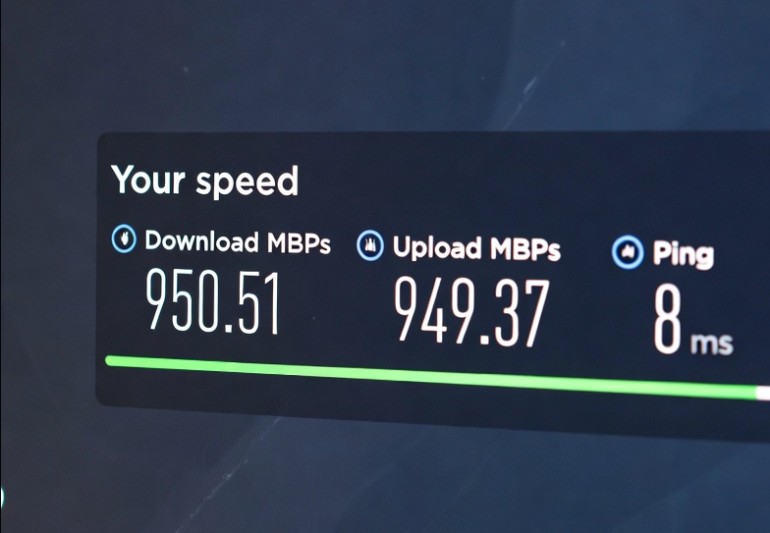
Speed is a big part of Pure Usenet’s offering – in fact, the name “Pure” hints that they focus on delivering straightforward Usenet performance. The actual download speed you get will depend on which plan you choose (20 Mbps, 60 Mbps, or unlimited). In our experience, Pure Usenet delivers the speeds it promises. If you subscribe to Pure XL (60 Mbps cap), you can expect to download at roughly 6–7 MB/s consistently, and on Pure XXL (uncapped) we were able to saturate a 500 Mbps fiber line without any trouble. The network showed no noticeable slowdowns even during peak evening hours. Pure claims to operate a “secure global backbone” with direct peering to major ISPs to minimize hops and latency – while that sounds like marketing speak, the result for us was indeed stable, maxed-out throughput.
All Pure Usenet plans allow multiple connections (8, 12, or 20 threads) which helps maximize your bandwidth. 20 connections on the Unlimited plan is plenty – unless you have a multi-gigabit internet connection, you won’t need more threads. (For context, some premium providers like Newshosting offer 50–100 connections, but that’s overkill for most users and mainly useful if you’re downloading at several gigabits or running many simultaneous streams.) Pure’s 20-connection limit on XXL is enough to saturate ~1 Gbps in most cases. By comparison, XLNed’s top plan also allows 12 connections for 120 Mbps, and UsenetBucket goes up to 25 connections on their 400 Mbps tier. In practice, all three providers can max out their respective speed caps without difficulty. The difference is that Pure doesn’t impose a cap on the XXL plan, so if you have a super-fast internet pipe (say 1 Gbps or above), Pure Usenet can take full advantage of it, whereas XLNed would top out at 120 Mbps and UsenetBucket at 400 Mbps.
Internationally, Pure’s servers are based in Europe. Users in Europe will generally see excellent performance and low latency. Users in North America or other regions might have slightly higher ping times connecting to EU servers, but it rarely impacts the download speeds for large files – you’ll still get the full throughput, just maybe 20–100 ms higher latency on each connection (which is usually unnoticeable in practice). All three services (Pure, XLNed, Bucket) are Euro-centric, so none has a particular advantage in global server distribution; if you specifically need U.S.-based servers for some reason, you’d be looking at a different provider entirely. That said, we did not encounter any issues pulling data from Pure’s network stateside – everything ran smoothly, and SSL encryption overhead didn’t slow anything down either. Essentially, as long as you pick the right plan for your needs, you can expect Pure Usenet to deliver the advertised speeds reliably. No throttling shenanigans were observed outside of the intentional speed caps on the lower tiers.
Server Connections, Ports & Configuration
Setting up Pure Usenet in a newsreader is straightforward. After subscribing, you’ll receive a username/password. The server details are:
- News Server:
news.pureusenet.nl - Ports: 119 or 80 for unencrypted connections; 563 or 443 for SSL-encrypted connections.
- Max Connections: 8, 12, or 20 simultaneous threads (depending on your plan tier).
These are standard Usenet settings – nothing out of the ordinary. Pure Usenet doesn’t impose any unusual configuration requirements. You can use whichever port works best for you (119 is default, 80 can be handy if a firewall blocks other ports, 563 is the default SSL port, and 443 can be used to masquerade Usenet traffic as HTTPS). SSL encryption is available on the secure ports, and we recommend using SSL (it’s included free) so that your ISP or others can’t snoop on your downloads.
Similar configuration applies to XLNed and UsenetBucket. For example, XLNed’s server is news.xlned.com (with the same ports above), and UsenetBucket uses news.usenetbucket.com (with ports 443/563 for SSL). All three providers support the common NNTP ports and up to a couple dozen connections. In short, if you’ve set up any Usenet service before, Pure Usenet will be familiar. And if you’re a newcomer, Pure provides clear instructions on their site to get you going – essentially just plug in the server name, your login, and choose an SSL port.
Provided Newsreader
One thing to be aware of is that Pure Usenet does not include any proprietary newsreader software with its service. When you sign up, you’re getting the Usenet access (servers, login credentials) but it’s up to you to choose and install a newsreader or NZB downloader of your choice. This is pretty typical among budget Usenet providers: neither XLNed nor UsenetBucket bundle a custom client either. They assume you either already have a favorite newsreader, or you don’t mind setting one up.
For some users – especially those coming from an all-in-one service like Easynews (which has a web interface) or Newshosting (which offers its own app) – this could be a slight hurdle. Using Pure Usenet means you’ll likely be using software like SABnzbd, NZBGet, or another third-party client. The good news is, Pure Usenet provides guidance on their website for how to get started. They have a tutorial section that walks beginners through picking a newsreader (they mention popular options like SABnzbd, NZBGet, NewsBin Pro, etc.) and how to configure it with Pure’s server. In practice, it’s a one-time setup that most people can handle, but it’s worth noting that Pure’s “no-frills” approach means no built-in search interface or one-click downloader app.
If you’re an experienced user, not having an included newsreader is probably a non-issue (you might prefer using your own favorite app anyway). But if you were hoping for a plug-and-play experience, you’ll need to invest a little time in setting up a client. The same goes for XLNed and UsenetBucket – they are access providers only, and you’ll use third-party software to actually browse and download from newsgroups. In our view, this is a reasonable tradeoff for the lower price. Just be prepared to do that initial configuration. After that, using Pure Usenet is as seamless as any other service.
Support Review
Pure Usenet’s support is what we’d call “standard” for a Usenet provider of this size. There is no live chat or phone hotline; support is handled via email (or a web contact form). Fortunately, the staff does respond in a reasonable timeframe. When we sent a couple of test inquiries (one technical question, one billing question), we received helpful replies in well under 24 hours. The replies were in clear English and addressed our issues directly. Pure’s website is available in both English and Dutch, and they offer support in those languages (the company is Dutch-based, but they cater to international users).
The self-help resources on the site are a bit limited. There’s a basic FAQ and some informative articles (mostly explaining what Usenet is and how to configure a client), but if you have a specific problem, you’ll probably end up contacting support. This isn’t unusual – XLNed’s FAQ, for instance, is also very sparse (only a few questions). UsenetBucket seems to put more emphasis on customer support by claiming 24/7 assistance and having a “Customer Advisory Panel,” but in practice that still boils down to email or ticket support too. None of these budget providers have the kind of extensive support portal or live chat that a bigger service might offer.
In terms of quality, Pure’s support gets the job done. They’ll help you with account issues, connection problems, or questions about your subscription without much fuss. The lack of live chat means you might have to wait a few hours for help instead of getting instant answers, but we didn’t find this to be a major issue. If anything, the responsiveness was better than expected for such an inexpensive service. Just set your expectations: support is via email only, and while friendly and competent, it’s not going to hold your hand extensively if you’re totally new. They assume a moderate level of user self-sufficiency (and their site guides reflect that). For most users, this level of support is perfectly fine, but very demanding or non-technical users should be aware that they won’t have a 24/7 live help desk at their beck and call.
Payment Options
Pure Usenet supports a broad range of payment methods, making it easy for both local and international users to pay. You can pay with major credit cards (Visa, MasterCard), PayPal, the Dutch online banking system iDEAL, or even via SEPA direct debit from a European bank account. They also accept prepaid Paysafecard vouchers, which can be handy if you want to pay cash anonymously. In the past Pure Usenet accepted Bitcoin as well, although that option isn’t prominently advertised now – it may have been phased out or could be region-dependent. (XLNed historically accepted Bitcoin too, since they share the same parent company, but it’s unclear if it’s still available on either service as of 2026.)
Aside from that, the payment process is smooth. We used a credit card on Pure Usenet’s site and it processed immediately, activating the account right away. If you use PayPal, you’ll be redirected to log in to your PayPal account as expected. iDEAL and SEPA are great options for users in the Netherlands/EU respectively, as they allow direct bank payment. UsenetBucket offers similar options (including PayPal and credit cards), so there’s no major difference among these providers on the payment front.
Final Thoughts
Pure Usenet lives up to its name in many ways – it’s a “pure” Usenet access service, stripping away the fluff and focusing on core functionality at a low price. After thoroughly examining its features, we find that Pure offers excellent value for everyday Usenet users, especially those who don’t need extras like an integrated reader or massive 15+ year retention. Its strengths include very affordable unlimited-speed access (the Pure XXL plan is a standout deal), solid retention of ~11 years which covers the vast majority of content people seek, and a commitment to security (SSL on all plans, plus an optional VPN that’s even included free on the top-tier annual plan). Performance is rock solid and on par with more expensive providers – downloads are fast and reliable, matching what you’d get from XLNed since they share the same backbone.
Speaking of backbones, one point that few reviews mention is that Pure Usenet and XLNed are sister services under the same company (reports indicate they fall under UNS Holdings, the group behind several Usenet brands). In practical terms, this means the two are almost identical in what they offer – same server farm, same retention, similar speeds – with just different pricing packages and branding. So if you were thinking of subscribing to both Pure and XLNed for redundancy, don’t bother; using one alongside the other won’t magically give you access to missing articles because their article databases are the same. For true redundancy, you’d need a completely different provider on another network. This isn’t a knock on Pure at all – the majority of Usenet providers are part of a handful of large networks – but it’s good for consumers to know.
So, who is Pure Usenet not for? In our view, Pure isn’t the best choice for absolute beginners who want a one-stop, turnkey Usenet experience (those users might be happier with a provider that includes a web interface or its own app, like Easynews or an ISP-style service). Pure also wouldn’t satisfy someone who needs the longest retention available or specialized perks like built-in Usenet search indexes. If you require 6000+ days retention to dig up obscure posts from the early 2000s, or if you demand 24/7 live support and hand-holding, you’ll be better off with a premium provider (and paying premium prices). Additionally, if you’re extremely sensitive about sharing any personal info, you might balk at the address requirement during signup – privacy purists might prefer a provider that takes just an email and crypto payment with no questions asked.
On the flip side, we think Pure Usenet is an ideal fit for users who are somewhat tech-savvy, value-conscious, and simply want dependable Usenet access. If you already have your own favorite newsreader software and maybe your own VPN, Pure gives you everything else you need to dive into Usenet at a fraction of the cost of the “big name” services. It’s great for Europeans due to its local servers and payment options, but also perfectly fine for North American users who don’t mind an EU-based service. Compared to UsenetBucket, Pure offers much longer retention and equally good speeds at a lower cost for unlimited use – so it’s a better long-term choice for heavy downloaders. And compared to XLNed, Pure’s plans are a bit more streamlined (no ultra-slow tiers), plus the option of bundled security tools gives it a slight edge for those interested in that.
In conclusion, Pure Usenet comes across as a reliable, no-nonsense provider that delivers on its promises. It’s not trying to be everything to everyone, and that’s fine. The trade-offs (no included client, somewhat shorter retention than the elite providers, and a basic support setup) are reasonable in light of the savings. We appreciate that Pure doesn’t lock you in – the 30-day money-back guarantee shows confidence in their service. Our slightly skeptical eye did catch a few areas for improvement (clearer communication on the VPN promo, and perhaps easing up on the personal details at signup), but nothing stood out as a red flag. At the end of the day, if you want cheap, fast Usenet access and you’re willing to handle the “extras” on your own, Pure Usenet is absolutely worth considering. It’s a provider that knows its target audience and serves them very well, while leaving the super-premium bells and whistles to others.